Before every session
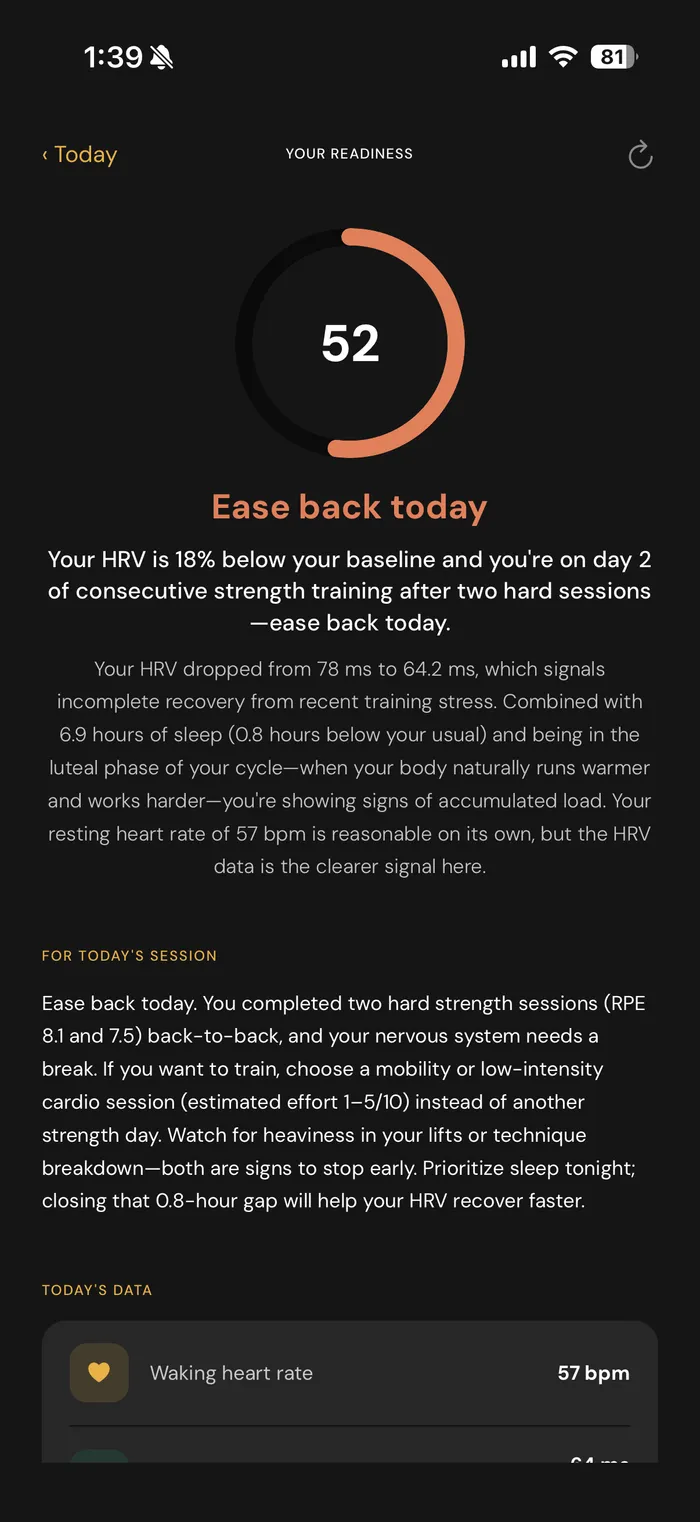
Zena reads your sleep, heart rate variability (HRV), resting heart rate and a waking heart rate signal from Apple Health, where your Apple Watch or other wearable saves them. Each day you get a clear read (Ready, Moderate, Ease back or Rest) and a specific suggestion for today's session, like lowering the weight, cutting a set or pushing harder, with the reason why.
If you track your cycle in Apple Health, Zena can factor that in too. It's optional, and it's treated as information, not a rule.
Your program, your way
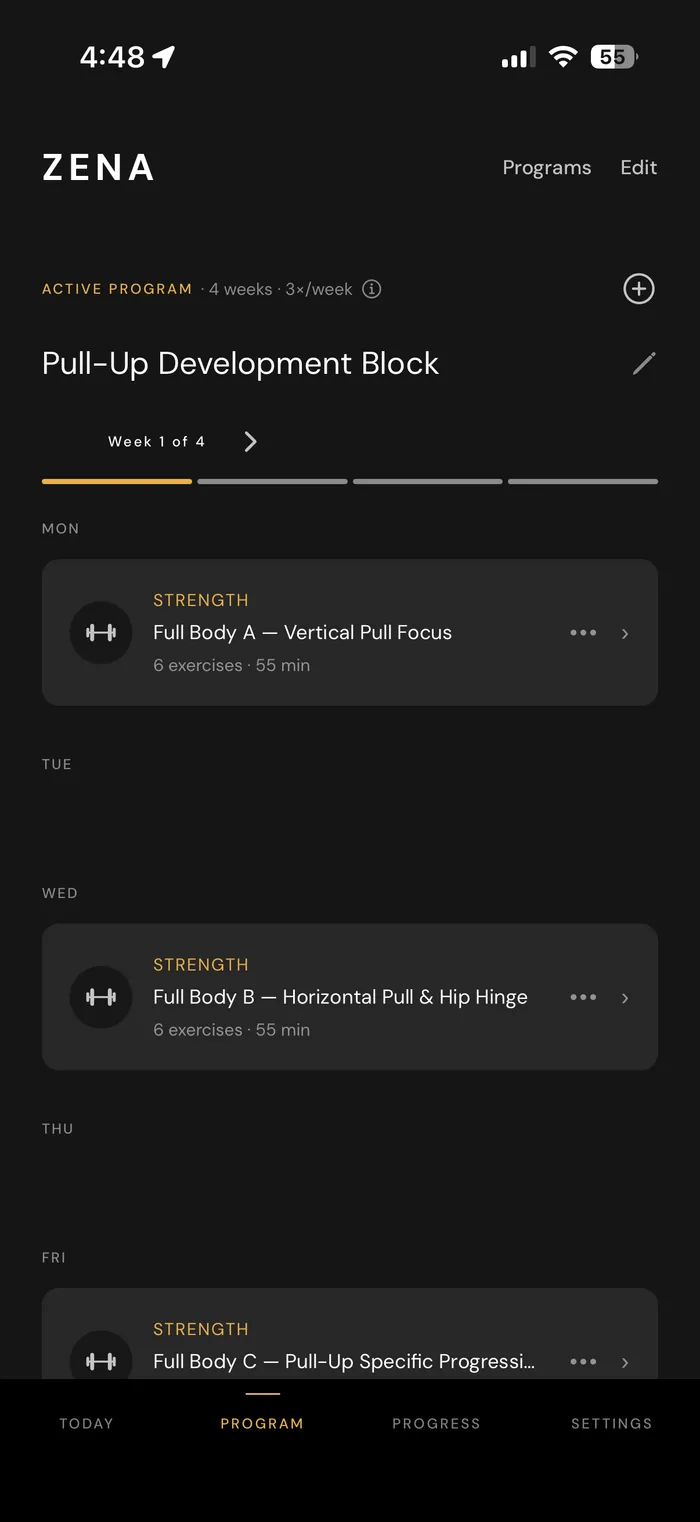
Tell Zena your goal, schedule, current lifts and equipment, and it builds a multi-week program around exactly that, sense-checking your goal against your timeline first.
Already have a plan from ChatGPT, a trainer or a spreadsheet? Paste it in. Zena turns it into a program you can track and adds the coaching on top.
During the workout
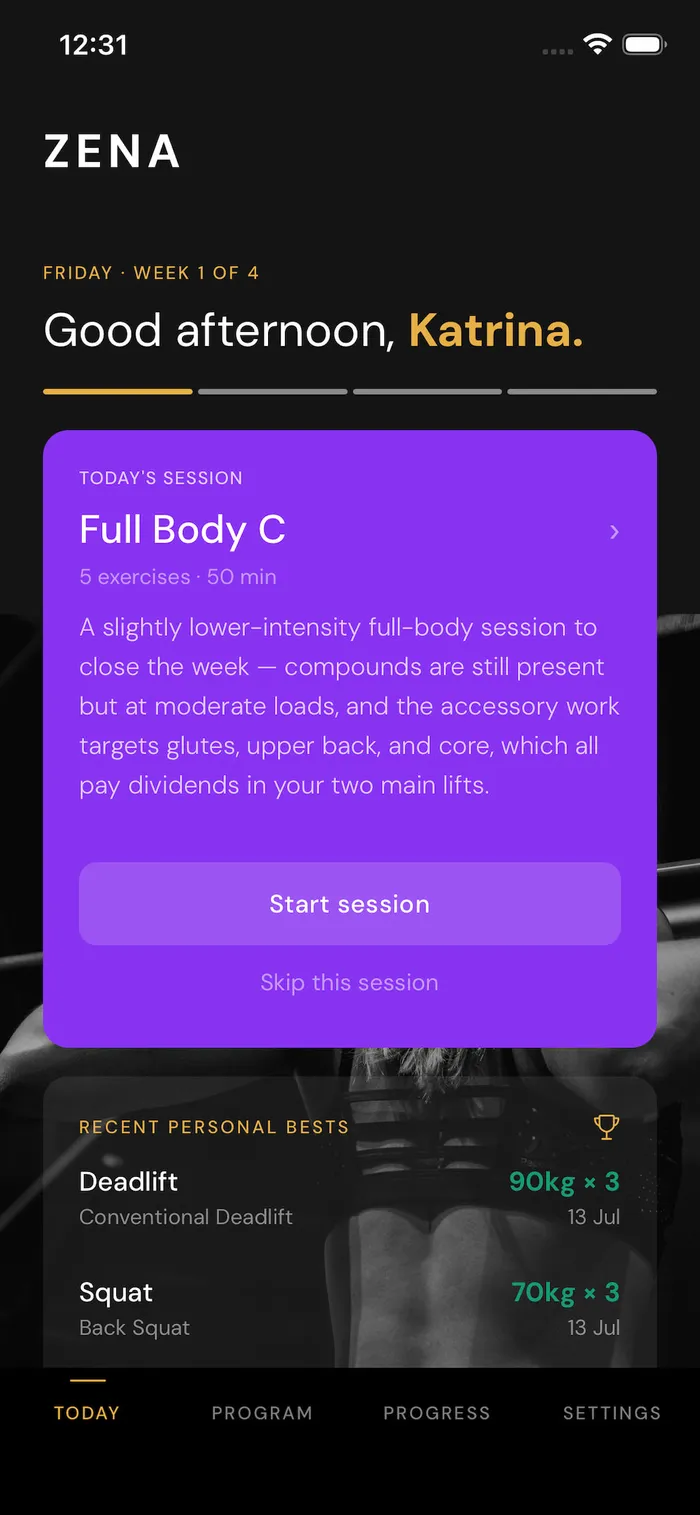
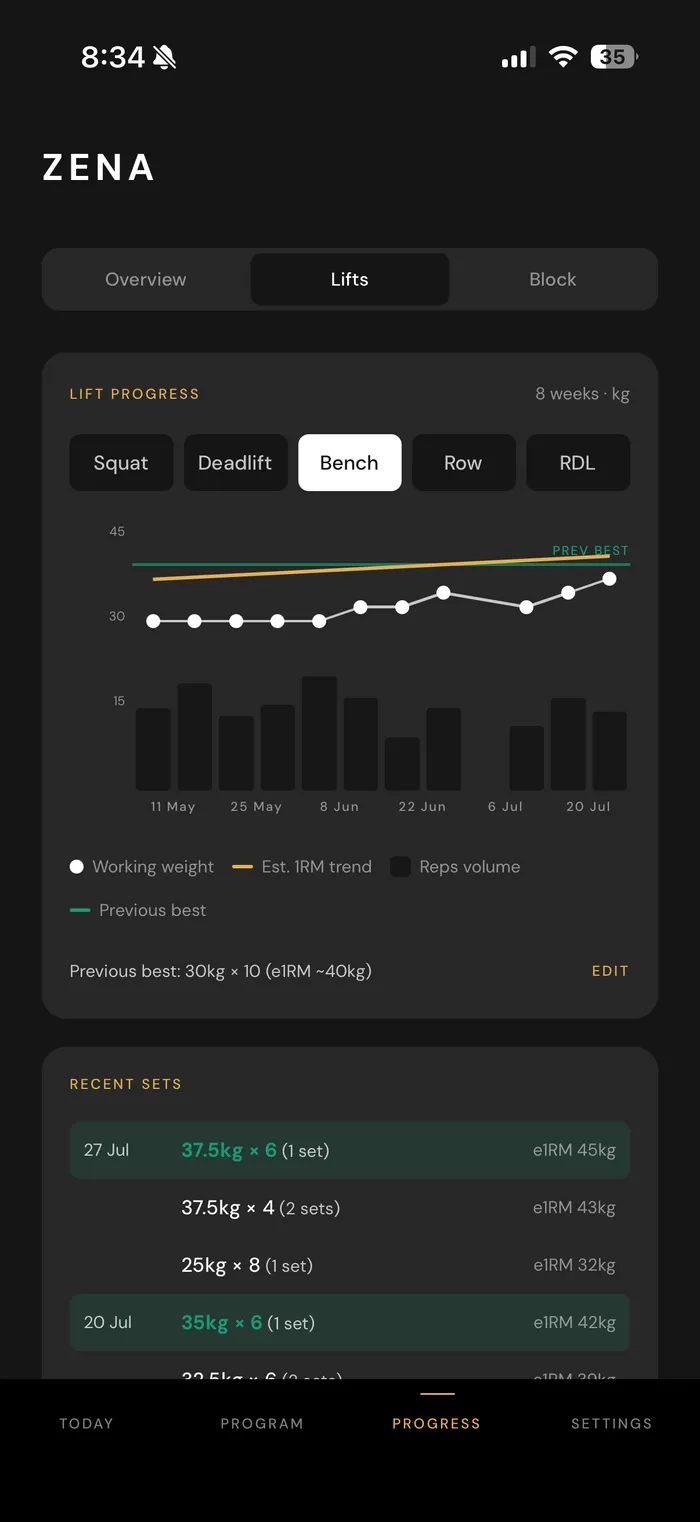
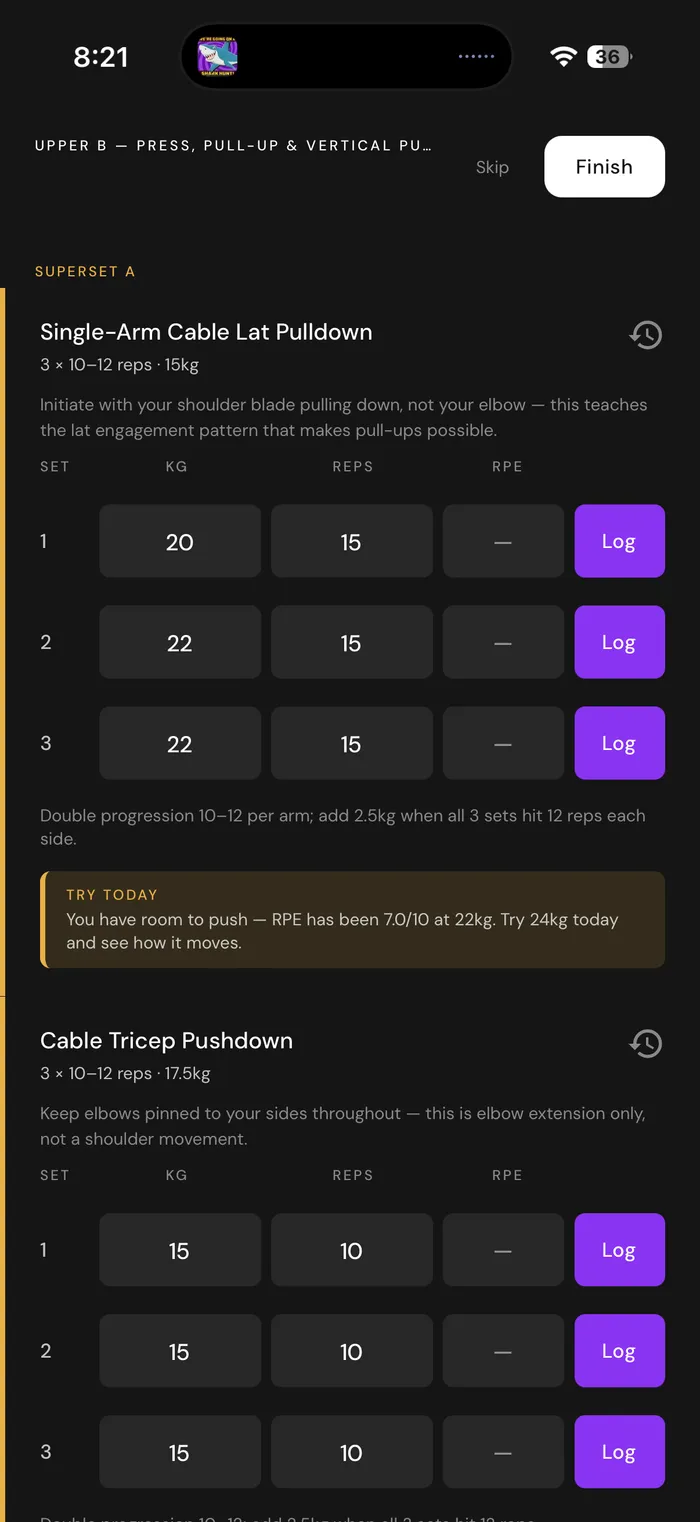
Every set is pre-filled with what you actually lifted last time. When your logged performance and recovery show you're ready, Zena suggests the next weight, using the plates and dumbbells you actually have. No spreadsheet, no scrolling back through a chat.
How Zena compares
| ChatGPT | Fitbod / Planfit | Zena | |
|---|---|---|---|
| Writes you a program | Yes | Yes | Yes |
| Logs every set you lift | No | Yes | Yes |
| Checks your sleep and heart data before each session and suggests changes | No | No | Yes |
| Imports a plan from ChatGPT, a PDF or a spreadsheet, ready to log | No | No | Yes |
| Built for women, and can factor in your cycle | No | No | Yes |
In the US, ChatGPT can connect to Apple Health and discuss your sleep, activity and other health data when you ask, but it doesn't check in before each session or change your plan on its own. Fitbod and Planfit estimate muscle recovery from the training you log. Zena's readiness features need an Apple Watch or other wearable. Competitor details last checked 30 September 2026.
Not ready for an app yet?
If you'd rather begin with AI chat, this prompt gets you a much better strength plan than "write me a workout". It works in ChatGPT, Claude or Gemini. Fill in the brackets.
Act as a strength coach and write me an 8-week strength training plan.
About me:
- Experience: [e.g. brand new to lifting / about a year of gym classes]
- Days per week: [e.g. 3]
- Session length: [e.g. 45–60 minutes]
- Equipment: [list exactly what you have, e.g. dumbbells up to 20kg, a bench, a cable machine]
- Current lifts, if I know them: [e.g. goblet squat 12kg for 10], or "I don't know yet"
- Injuries or movements to avoid: [or "none"]
- Goal: [e.g. get stronger at squats and do my first push-up from the floor]
Please:
1. Use full-body sessions built around a squat, a hinge (like a deadlift or hip thrust), a push and a pull, plus one or two extra exercises.
2. For each exercise, give sets, a rep range and rest time.
3. Tell me how to choose a starting weight in week 1 if I don't know my numbers.
4. Give me one clear rule for progressing: exactly when to add reps and when to add weight.
5. Build in one lighter week and tell me when it is.
6. Give one alternative for each exercise in case the equipment is busy.
7. Put the plan in a simple table I can copy into a notes app or a training app. Prefer not to do steps 3 and 4 by hand? Import the plan into Zena. It keeps the log for you, pre-fills last session's numbers, and tells you when to go heavier.
Common questions
ChatGPT is a good way to get a first plan. What it doesn't do is run the plan with you. It doesn't log your sets, and it won't change today's session on its own. (In the US it can discuss your Apple Health data when you ask, but it doesn't check in before each session.) Zena logs every set, pre-fills what you lifted last time, checks your sleep and heart data before each session (with an Apple Watch or other wearable) and tells you whether to push, ease off or rest, and suggests when to go heavier. Already have a ChatGPT plan? Import it and keep it.
Fitbod and Planfit build your workouts and estimate muscle recovery from the training you log. Zena also reads your sleep, HRV and resting heart rate from Apple Health (you'll need an Apple Watch or another wearable), so a bad night's sleep can change what it suggests for today's session, not just how recovered it thinks your legs are. It can also import a plan you already have, and it's built for women, with your cycle data from Apple Health factored in if you track it. A few newer apps also use wearable data, so if that matters to you, check what each app actually reads.
Yes. Paste in a plan from ChatGPT, a trainer, a PDF or a spreadsheet, and Zena turns it into a program you can track, with logging, progression suggestions and recovery-based suggestions on top.
No. You can build or import a program, log every workout and get progression suggestions without one. The readiness score and recovery-based recommendations read sleep and heart data from Apple Health, so for those you'll need an Apple Watch or another wearable that saves that data there. Zena itself is an iPhone app; there's no Apple Watch app.
No. RPE (rating of perceived exertion, how hard a set felt on a 1–10 scale) is optional to log, and Zena explains its readiness reads and recommendations in plain language.
Zena has a 14-day free trial, so you can build or import a program and see how it adjusts before you pay. After that, it's $5.99 USD a month, or $49.99 USD a year with foundation pricing.
Not yet. Zena is iPhone only for now.
An AI workout planner is a tool that uses AI to create a training program from what you tell it: your goals, experience, schedule and equipment. The best ones keep going after the plan is written, tracking what you lift and adjusting the plan as you go.